Church and Life
Volume LXXIV, Number 2
Welcome to the April 2026 Issue!
We open this issue of Church and Life with "The Blue Anemone," a poem by the Danish priest, poet, and freedom fighter Kaj Munk. The poem expresses Munk's astonishment at God's grace and the hope he witnesses with the return of spring. The Rev. Megan Eide offers a sermon on John 4, which she interprets through the lens of the Danish concept of "hygge."
The three travel narratives included in this issue return to the concept of hygge, first in Conan Griffin's account of a snowy hike through Mols Bjerge in Jutland and a cozy dinner party in Roskilde and, second, in Sarah Chew and Ana Wright's reflections on their three-day visit to Zealand. Carsten and Sonja Jensen tell about their own travel, this time to the USA, where they found Southern hospitality (possibly a distant cousin of hygge?), as well as strange traffic and gun laws.
In "Dateline Denmark," Edward Broadbridge tells about his experience as the translator of six volumes of Grundtvig's writings— some 580,000 words! Copenhagen University scholars Nanna Eva Nissen and Kim Arne Pedersen explain GMO, a new project aiming to transcribe and make available the 80,000 pages of Grundtvig's unpublished writings, many of which have never been read closely, that are kept in the Royal Library of Denmark. Jens Wendel-Hansen, also a Grundtvig scholar, responds to recent statements by the Trump administration about Greenland with a brief historical overview about the relationship between Greenland and Denmark and some information about what Grundtvig thought about that relationship. And Karoline Præstholm contextualizes the recent elections in Denmark from her perspectives as a graduate student in Political Science and as an intern with the Danish Broadcasting Corporation.
We close with a reminder from Anita Young to make plans to attend the Danebod Folk Meeting in Tyler this August 12-23, and with a postscript from the editor, Brad Busbee.
In the June issue of Church and Life, we will be celebrating Scandinavian ancestry. Please send us stories about your ancestors, whether those stories are documented or drawn from memory, family tradition, or even local legend. We want to learn about your family through the generations, how they made their way in the world and what they left for posterity's sake.
Church and Life strives to be a forum for stories that speak to shared curiosity and experience. So we welcome stories of all kinds. (You can email these accounts directly to me at mbusbee@samford.edu.)
Please support Church and Life in this effort!
Church and Life is a storied publication, now beginning its 74th year! If you want to know more, click the "About Church and Life" button above. The media landscape in the 21st century is increasingly crowded with mindless content; publications like this one, ones that highlight community and tradition, need your financial support more than ever before. Church and Life is free to read, but its production is not free. Its vitality depends on voluntary donations from readers like you.
There are two easy ways to give:
- Click on the “Make a Donation” icon here or when you enter the homepage for Church and Life at churchandlife.com.
- Mail a check (Pay to the order of Church and Life) to:
Andrés Albertsen
1405 19th Ave SE Apt 103
Willmar MN 56201.
A donation of any amount will be tax deductible. Whether you decide to make a gift alone, with a group of friends, with your family, or on behalf of your business or institution, we are happy to work with you. If you would like to sponsor an entire issue, the cost is $ 1,500. Whatever you decide, your donation will be greatly appreciated.
The Blue Anemone
by Kaj Munk
What was it that befell me?
How did my winter-frozen heart
come to melt within me
on this, the first of March?
What pierced the dark and heavy ground
and spread with tender blue around
a hint of heaven’s progeny?
The little anemone,
I planted last year on my own.
From Lolland once I brought it,
a gentle touch from where I’m from.
Then here I waited, thought it
would fade before the spring could come;
it missed its woodland sheltered space,
its warming air, its fertile place;
within this cold antipathy
would perish my anemone—
I’d never see it grown.
Now it stands and sways right here,
triumphant in Jutlandic sand,
unyielding through the grey years,
the winds and the chill withstands;
as if the trials it has known
have made a greater strength its own,
and built an enduring memory—
and yet my anemone,
like lake-waves softly shone.
What was it that befell me?
My heart so cold, so hard as stone,
it melts again to tell me
it blooms the first of March alone.
“I’m parted from all joy,” I said,
my soul from gladness long since fled
in winter’s cruel monotony.
Now does my anemone
make all my heart its own.
For this pure hue it’s wearing
is like a baptism of spring,
it leaves me newly sharing
as endless hope takes wing.
So I bend gently to the ground
and stroke your silken petals round,
a grace from heaven’s epiphany.
You little anemone,
how great the Maker has shown!
About this poem: Kaj Munk
(1898-1944)
wrote "Blå Anemone" in the spring of 1943 after noticing a rare blue anemone blooming near his parish in Vedersø in western Jutland.
The sight made a strong impression on Munk because the flower appeared in an environment where it was not expected to thrive—poor sandy ground rather than rich forest soil where such flowers are usually found. Its delicate beauty, combined with its surprising resilience, became the immediate inspiration for the poem.
The flower also became a powerful symbol. Denmark was under German occupation during World War II, and Munk had become an increasingly outspoken critic of the Nazis. In this context, the blue anemone took on symbolic meaning: It represented hope, quiet resistance, and the persistence of something pure and fragile under harsh conditions — through God's grace.
Munk’s personal situation deepens the significance of the poem. As both a pastor and public figure, he was under growing scrutiny, and tensions in Denmark were rising toward more active resistance. In January 1944, he was assassinated by the Gestapo, an act of violence that has led many to read "Blå Anemone" as almost prophetic or as a sign of his growing awareness of immanent Providential change.
Today, the poem is remembered for its lyrical beauty and, especially, for its powerful message about resilience and moral courage in a time of oppression.

Jesus and Hygge: A Sermon on John 4: 5-42
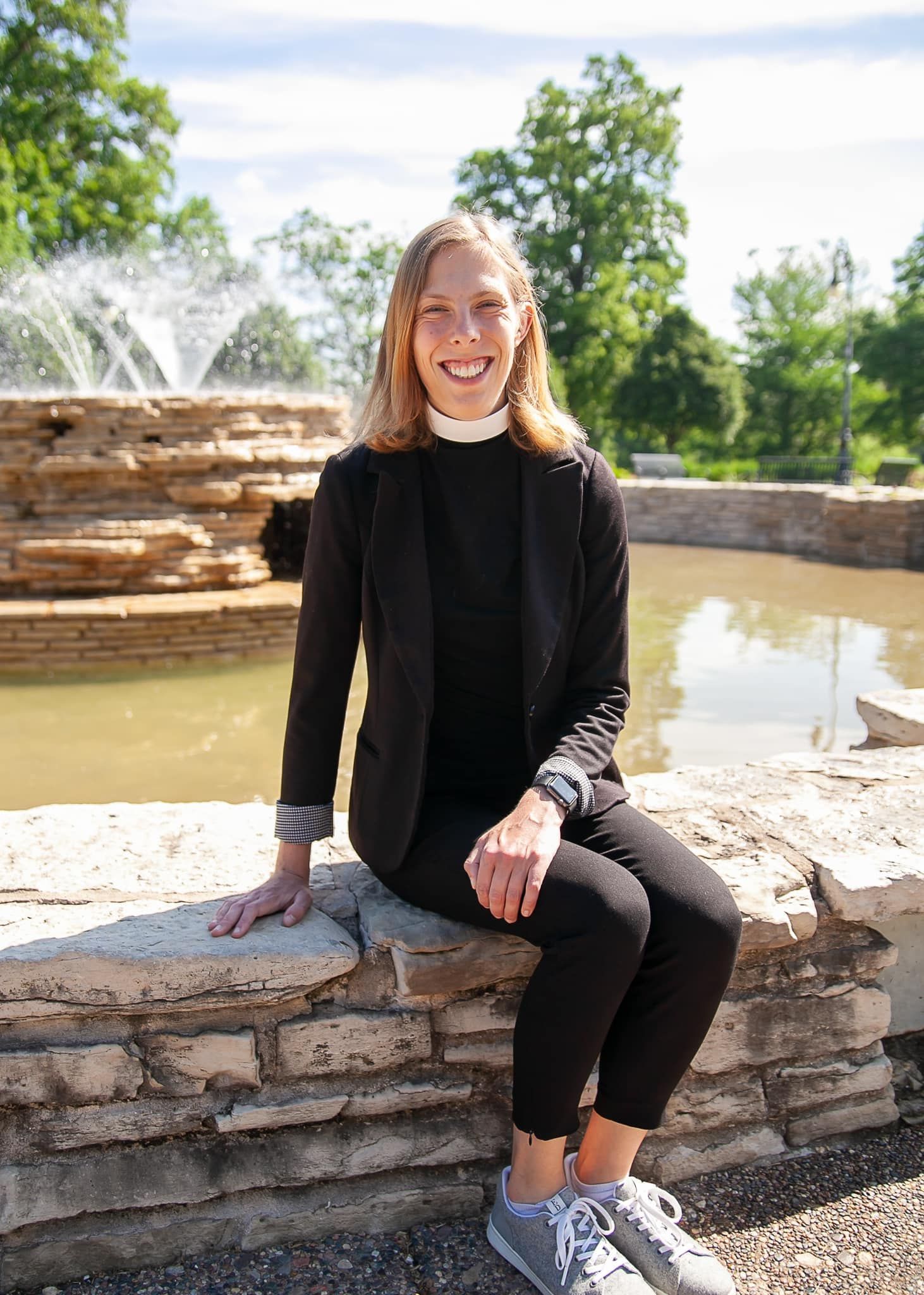
by Rev. Megan Eide
You really can’t have grown up in a Danish Lutheran church like Danebod or have lived in a Danish-settled community like Tyler without having heard the Danish word “hygge.” Hygge is a notoriously impossible word to translate into English or any other language for that matter. It’s the uniquely Danish way of describing a thing or a situation we might call “cozy” in English; it's something that brings an ordinary, everyday sense of contentment and joy. The classic example is sitting beside a warm fire on a Friday night, with a mug of tea or hot chocolate, perhaps a good book or a good friend, and watching the snow gently fall outside. Hygge can be whatever brings a happy sigh to your lips and a sense of peace and calm to your spirit. Sometimes hygge is sharing a meal with a good friend, someone with whom you can just let your guard down and be wholly and unapologetically you. Sometimes hygge is a serene, special moment with a grandkid like reading a story to them as they start to doze off in your lap.
Sometimes hygge is a solitary stroll in nature, where the design of a leaf or babble of a brook captures your fascination and just melts away the cares of the world.
When was the last time you experienced hygge? A time when you felt fully present, not bothered by the past or distracted by the future; a time when, for once, you felt content, meaning whatever it was you were doing, whoever you were with, you felt as though this was enough to be at peace in the here and now? The here-and-now aspect of hygge is so important because that’s what makes it realistic. Hygge doesn’t wait for all of the world’s problems to be solved or even postponed. Hygge doesn’t require that every need is met and every goal is achieved before you can be allowed to feel happy and secure. Hygge is finding a genuine sense of ‘enough’ in the midst of not enough; enjoying stillness and safety in this ever-moving, never quite predictable life.
Now, the Danes can certainly take credit for the word “hygge.” We can even let them have the copyright on all of the books out there about how to have more hygge in your life. But—and I’m terribly sorry to be the one to tell them this—the Danes are not the inventors or originators of the hygge experience, nor are they the ultimate source of authority on hygge. For that, all thanks and praise goes to God. Let me show you why.
Look to the Gospel of John, the fourth chapter. Jesus and his disciples are on the road from Judea to Galilee, a distance of something like 80 miles. They are slogging their way through the hot, dusty desert and, by high noon, they can go no further. The sand is burning hot, the sun is scorching, and their energy levels are completely spent. It’s time for a break. So, in the region of Samaria, in a little town called Sychar, Jesus does the equivalent of a toddler-gone-rag-doll, flopping down next to a well just outside of town. The disciples, playing the role of Jesus’ wise caretakers, recognize that they need to water and feed their Messiah before he can keep going, so they let him relax by the well while they go into town for provisions.
Here enters a woman from Samaria alone, with an empty jug she intends to fill at the well. As today’s readers, you and I are probably a lot like the other people in her community. We’ve likely heard the gossip about this woman’s past, like the rumor that she has had several failed marriages or the rumor that she has to draw water at the worst time of day all alone because she has no friends and needs to avoid any bullies in the process of doing her chores. But, also like the Samaritan woman’s community, we probably don’t know the full story. She could just as well have had many tragic circumstances preventing her from settling with a long-term partner. And it’s not unreasonable to believe this independent woman simply went to get water without a posse to slow her down! Who knows? And really, it doesn’t matter. At least, she doesn’t need a perfect life to have a perfect connection with Christ. I think, sometimes, we assume that the ideal relationship with the Lord looks like a pretty sanitized version of faith, where we give all glory, laud, and honor to God all of the time, through endless praise, perfect obedience, and unquestioning belief. And, in a lot of ways, that is the Biblical ideal, especially if you’re reading decrees from God in the Old Testament or songs for worship in the book of Psalms. However, when we read the Gospels and Jesus’ real-life relationships with everyday people like you and me, we find something that’s more ordinary than extraordinary; the bonds are more humanistic than idealistic; more momentary than general. In other words, more hygge.
For example, in this story, Jesus and the Samaritan Woman have a genuine dialogue. Jesus asks her about her life, her relationships and what it is she is really looking for to feel fulfilled. In turn, the Samaritan woman asks Jesus a few honest questions about faith, ones on her heart and mind. She doesn’t try to put on airs and qualify her ideas with a fluffy sort of politeness that beats around the bush. She gets right to voicing her concerns, namely, is Jesus really the all-powerful, all-good Messiah he claims to be? Notice too, nothing about this scene from the outside signals perfection or finitude. Jesus is still an unhoused, dusty, thirsty traveler on a much bigger journey with a longer, harder road yet ahead. The Samaritan Woman at the Well is still, in many ways, alone, without a close personal friend or partner.
None of their big issues are erased or resolved through Jesus and the Samaritan Woman’s brief encounter, but for this one ordinary, human moment, they are enough for each other. Both Jesus and the Samaritan Woman are content in the company of one another, safe in the sincerity of their conversation and relationship, free from the burdens of the present and weight of the future. Here’s how we know this Truth. At the end of their time together, before the woman goes off to share the good news about the Messiah, she sets down her empty water jug, leaving it behind. It’s just as Jesus told her: By drinking in his Spirit and soaking up the hygge of their time together, she reached a point of true contentment. She was no longer thirsty but nourished with the living water of Christ.
Many people who have heard this story preached year after year have probably come to notice and understand the importance of that detail near the end, when the woman finally gets her fill of living water and leaves her jug behind. But I wonder, how many of us have noticed a similar hidden detail? Remember, at the beginning, Jesus was worn out himself, also needing food and water. But by the end of the story, after his honest, everyday, genuine conversation with another person after God’s own heart, Jesus, too, is filled. When the disciples return and offer him food, Jesus tells them, “I have had food to eat that you do not know about.” Jesus is fueled and fulfilled by the momentary, ordinary, everyday chances to foster a genuine relationship with us.
In biblical Greek, the word for this kind of faithful, reciprocal relationship with Jesus is “meno,” which means “to abide.” It is how the Spirit of God abides with and becomes at home in us and we in turn become at home in the Spirit. We see that meno/abide is used more frequently in Scripture in the lead up to Easter. That said, meno probably won’t take off as a trendy lifestyle concept like hygge, but meno really is an accessible way to practice faith in an imperfect, ever-changing, ever-challenging world. We can, genuinely and repeatedly, abide with God, where we are, as we are. And God will genuinely, readily abide with us.
Really, what could be more hygge than that? Amen.
The Rev. Megan Eide
is the solo Pastor of Danebod Lutheran Church (Tyler, MN), the Director of the Danebod Folk School, and a part-time PhD student with the University of Aalborg, Denmark. Connect with Megan about Danebod’s many ministries, including the Danebod Fall Folk Meeting and an online Danish Learning Group, by emailing her at
pastormegan@danebodlutheran.org.
Lessons from Winter Travel in Denmark
by Conan Griffin
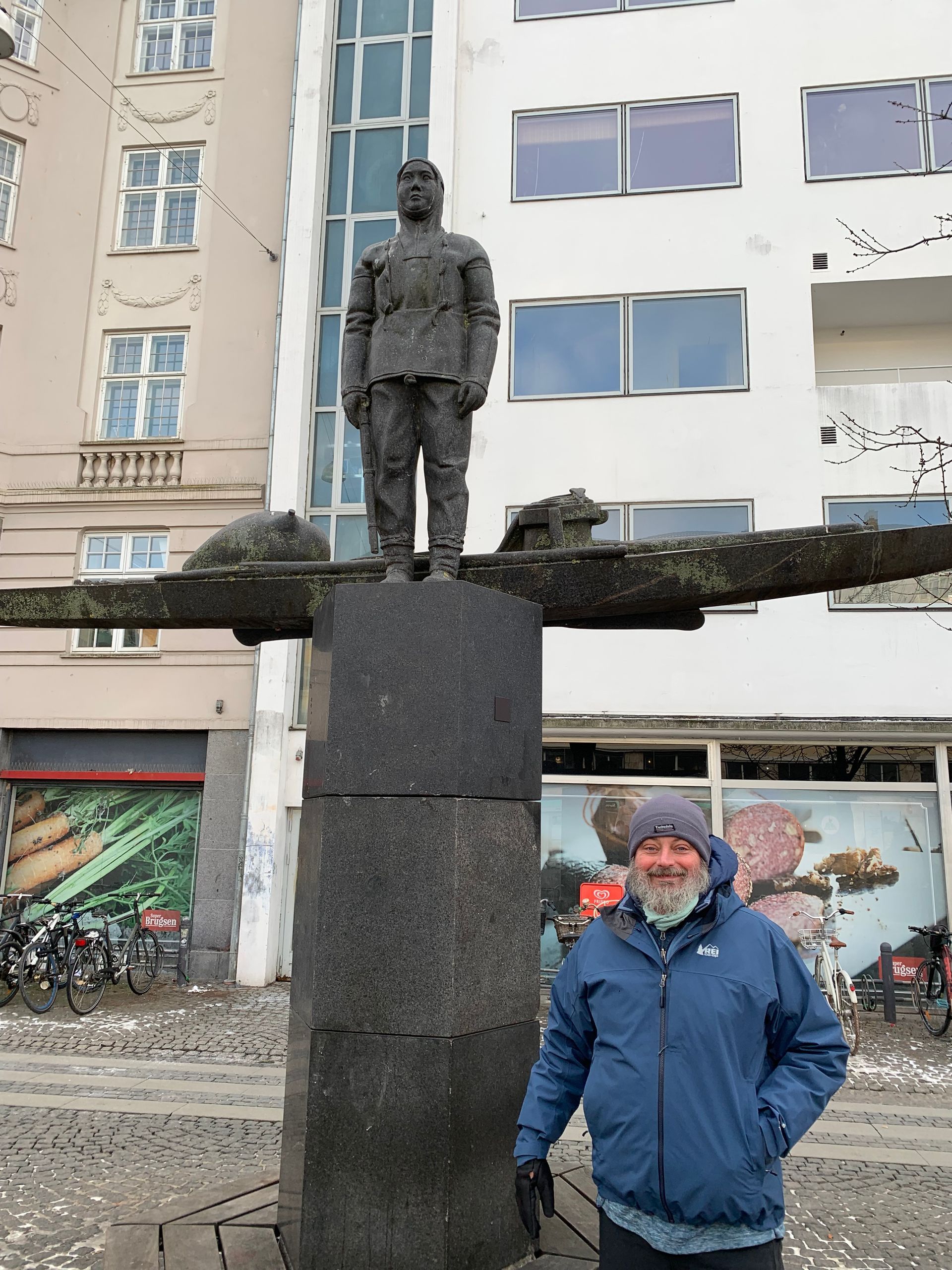
My Airbnb host in Rønde, Denmark, said, “You are very brave to come here and hike the Mols Bjerge trail in the winter. We don’t see many tourists here at this time of year.”
“Thank you,” I said, not knowing if he admired my adventurousness or thought me foolish. Either way, I’ve learned that most people won’t take offence to “thank you.” It might make you seem even more foolish than they initially thought, but it won’t offend.
Two nights earlier, I had attended what is very likely the best dinner party I’d ever been to. It was hosted by a Danish family I’ve known for years and was simply dripping with hygge.
Remembering it now, it seems almost like a series of acts in what Tennessee William’s termed a memory play, where some details are exaggerated and some diminished in the remembering of it.
Three scenes stand out.
In the first, we are gathered in eclectic assortment of chairs, couches, and benches being introduced to one another by our host. He goes from one to the next telling the group about each person, almost like a herald announcing someone at court. We are all comfortable. We are nibbling on hors d’oeuvres and sipping something warm or cold depending on preference.
In the second, we are seated around a long rectangular table with low-hanging lights. The light is diffuse, intimate. Plates of homemade dishes are passed from one person to the next, and conversations bubble up and carry on in little enclaves. There are no loud conversations; here, too, the sense of intimacy, of closeness, prevails.
In the third, when all had satisfied themselves with meat and drink (to paraphrase Homer), we are still at the table, but the dishes have been cleared, and we are gathered around for a new game that someone has just found and brought. It is a card game, and everyone joins in enthusiastically. The quietude of scene has been replaced by a boisterousness that will keep our spirits up into the late hours of the night. This, to me, is hygge. (While I encountered other hygge-ly spaces, none included the same warmth that fellowship engendered.)
Other than my first hours shuffling across the windswept landscapes, both urban and suburban, this is my first memory of Denmark. It is also where I learned that, regardless of my Airbnb host’s thoughts, the dinner-party people thought it adventurous—once they understood where I was going, that is.
It took many attempts because, well, Mols Bjerge sounds very different when pronounced phonetically in English. Rather than trying to explain, just take a second and pronounce it using English “j” as in “jet” and “g” as in “get.” Then, you may understand why the dinner guests thought it hilarious and asked me to say it in English numerous times throughout the evening.
The rest was windswept—at least in January. The day after the dinner party finds me in Copenhagen’s new bus station, the one near an IKEA on the periphery of the city. It is bitter cold and made more so by the fact that the bus is late. When it does arrive, the driver insists that most of us, myself included, are not on his bus roster, so he leaves us standing in the cold with no indication of when the next bus will arrive. We are at the farthest bus bay, so we cannot risk waiting in the terminal. We wait in the wind and cold instead—for another hour. When a bus does pull up, it is the same bus and the same driver: He had been mistaken. We board, shedding our coats and nestle in. Over the next hour, the bus carries us west and then north and then west again. What you cannot hear of the wind from inside the bus, you can feel, as the bus intermittently shuffles from side to side.
We make our way towards Yderby lyng, on the northwest tip of Zealand, and onto a ferry. The ferry chugs across the Samsø Bælt (the body of water between Zealand and Jutland), rolling from side to side on a windswept, storm-dark sea, until pulling into the Bay of Aarhus and docking in Aarhus itself. There is another bus and another one after that brings me finally to Rønde, the location of one terminus of the Mols Bjerge trail. Here, in Rønde, I meet my Airbnb host, the one who commends me on my bravery (or foolishness).
It turns out he is correct—in both regards.
The Mols Bjerge trail includes four stages, beginning or ending in Rønde or Ebeltoft depending on which way you go. Each stage is about 20km and well-marked. If you start in the West, the first stage, the Kalø Stage, you begin in Rønde and end in Femmøller.
I begin on a sunless and rainless day, which seems like a victory. I am prepared for rain but glad to not have to put those preparations to use. To save time on that first day, I skip the first 6-7 km through Hestehave Skov and Ringelmost, where wide, lovely trails pass recent historic sites as well as Viking sites from over a millennia ago. Given the state of these ancient sites, it is difficult to tell much from the small piles and otherwise strewn rocks in the clearings; it is, however, stunning to think about the men and women who lived there, with whom you now share this connection of place across time and space. After the forest, much of the Kalø Stage is by road. Stretches along Molsvej and others follow smaller roads through old hamlets. Some stretches trace farm roads and one stretch, the final one, crosses cow pastures, before dumping out onto a road on the outskirts of Femøller. This stage, as my host will tell me, is the least exciting. Unfortunately, it is my first and last stage.
Here my foolishness stands at the fore. At home in the US, I had researched the trail and the distances and the towns. What I had left to chance was finding a place to stay off-trail each night. This is no easy feat in the summer, I would learn and near impossible in the winter. Back in Rønde on the second night, my host calls someone in Femmøller who would have a place to stay—if only she weren’t in Argentina for the off season! My host also says that there is a dearth of hotels, hostels, Airbnbs, etc. in Femmøller or Ebeltoft. There are talks of opening some, he says, but it’s been many years.
Here I am faced with two options: see my foolishness to the end or, as a friend of mine once said, Pfft, “pull the shoot and bail.” Pfft. That’s me. I pull the shoot and set off for a night in Aarhus before embarking once again out onto the windswept Bay of Aarhus, across the Samsø Bælt, and along the highways that bring me back to Copenhagen’s new bus station, the one next to the IKEA on the periphery of town.
Learning Abroad: From Alabama to England to Copenhagen
by Sarah Chew and Ana Wright
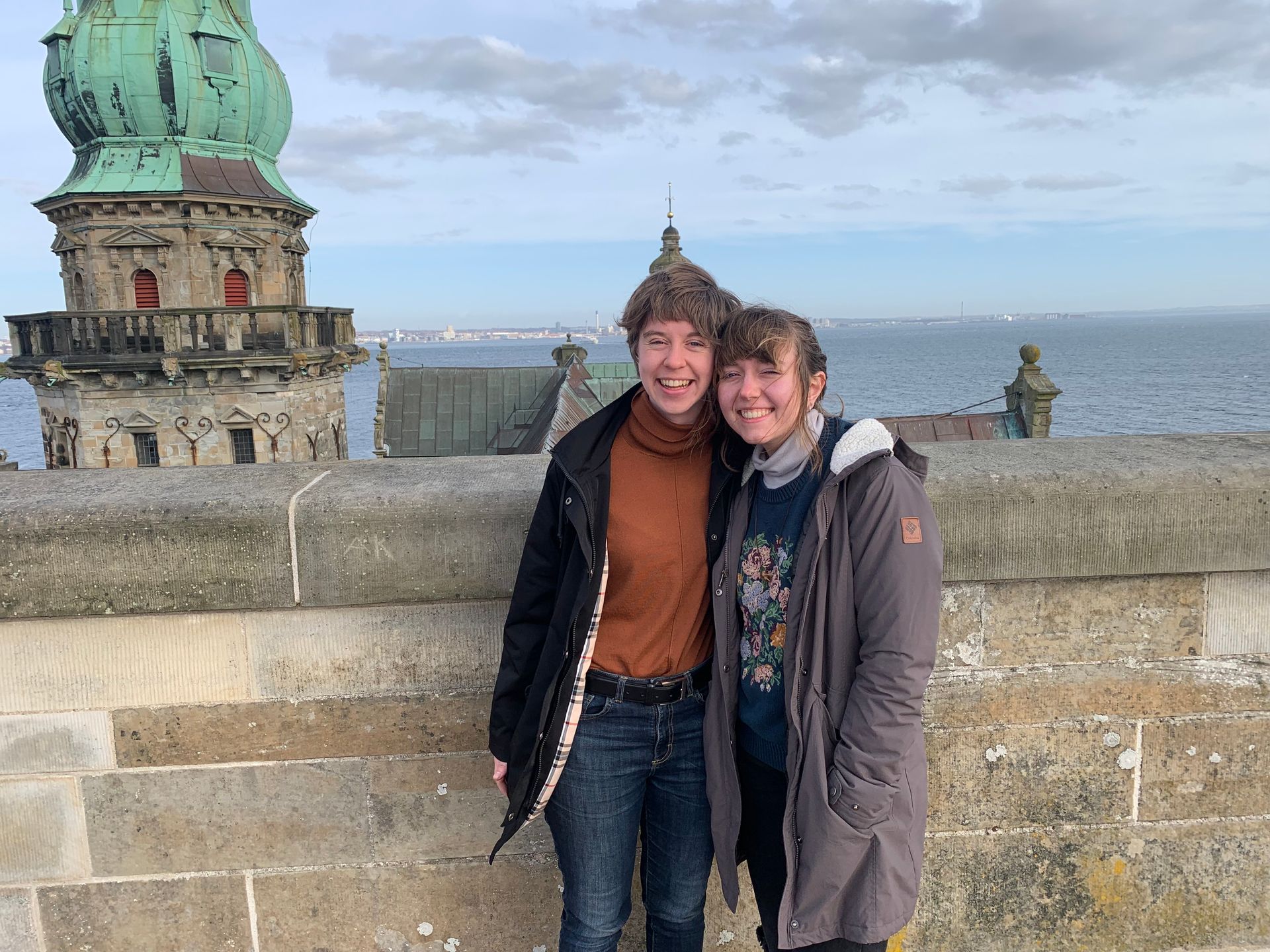
This March, we visited our former professor, Brad Busbee, who is on sabbatical in Denmark. Although we began our studies in Alabama, we have both ventured abroad to continue our education (Sarah is reading for a master’s in theology at Oxford University, and Ana is studying and doing an internship in London). For the three days of our Denmark visit, we chatted with scholars at Copenhagen University, sampled smørrebrød (open-faced sandwiches), and visited the International People's College (IPC), a Danish folk high school in Helsingør where we also wandered through the dusty casements of Kronborg Castle, the setting of Shakespeare’s Hamlet. The visit to Denmark was perfectly timed: Recently, we’ve both been thinking about our place in international education, from the vantage points of student and teacher, so our experience in Denmark, though short, forced us to reflect. We offer a few of those reflections here.
Sarah: I moved cross-country for my undergraduate education, from Albuquerque, New Mexico, to Birmingham, Alabama, and I’ve since moved across an ocean for a graduate degree. More than the studies themselves, the biggest challenge I've found to be adapting to the idea of “place” that surrounds that education. Looking back, I can see how the rhythms of life in Alabama were shaped by its humid summers, hospitality culture, and even the sound of church bells on Sundays. In Oxford, I’ve seen how influential the climate is: students escape the dreary, dark winters by gathering in pubs, and there seems to be universal agreement that rain and lack of daylight hamper the motivation to learn.
In Denmark, I was struck by how strongly rooted the sense of “place” in education seems to be. I encountered the concept of “hygge,” a cultural value that seems to encompass both physical coziness and emotional contentment. I heard people use the word--what I might paraphrase as “cozy”--to describe homes, jazz clubs, cafes, classrooms, and aquariums. It is a way of combatting the long months of cold and darkness here, but unlike in Oxford, the need for warmth and companionship is built into Danish culture.
In Helsingør, I visited an international folk school, where students ranging from high school age to middle age come from all over the world to learn together. The teacher showing us around took us outside and showed us derelict beehives that he’s hoping to restore. Other students were in the middle of a gardening class, and we found four or five of them climbing trees and putting up birdhouses for owls and songbirds. Another student was assigned to plant seeds for a garden, so we joined him in putting compost and soil into pots and then adding leek seeds. In these ways, students are encouraged to use their hands and feet to grapple with the place where they live.
Likewise, students each have a chance to give a short showcase of their home country. In a general assembly, we heard a student from Japan give a short speech to commemorate the fifteen-year mark of the Fukushima nuclear accident. It seems to me that the international folk school education is structured around these tensions of place: Each student offers the contribution of having lived in a different country, but everyone is expected to participate in and be molded by Danish life, too.
Pluralism is stamped into American life, more so than in Denmark. But, Americans aren't always good at understanding how to function a multicultural society or understand the vast differences in our country’s regions. Perhaps schools are a good place to think in a more robust way about what it means to live in a place, and Danish culture offers one model for how to do so.
Ana: During my past few months studying in London, I have taken advantage of many discounted flights at ungodly hours of the night to travel to several countries throughout Europe. It is a cultural whirlwind to arrive in a new place with a new language and layout and suddenly have to orient oneself, but I have found that the best way to feel grounded is to talk to locals and hear their stories. Indeed, one reason that I decided to study English Literature at university is because I am convinced that storytelling is a powerful bridge across cultures, places, and times, and traveling has further proven this to be true. Nobody experiences the world objectively, but stories give us access to the memories and values which shape the perspectives of people who are different from us.
In Denmark, I was excited to find storytelling woven into the very fabric of society. In Copenhagen, for example, Sarah and I made a point to visit the Little Mermaid statue commemorating Hans Christian Andersen’s tragic fairytale, and in Helsingør, we learned about the legend of Holger Danske, who sleeps beneath Kronborg castle, ready to awaken whenever Denmark is in need. Folk stories such as these provide heroes that embody shared values, helping to bind people together within their own culture.
In Helsingør, when we visited IPC, our guide, Josh Campbell, a visiting teacher from Canada, told us about a world storytelling class that he was taking. They were studying the storytelling methods of many different cultures and using these insights to help develop their own storytelling methods. This kind of cultural exchange seems to be a value of IPC in general. Josh also told us about how, during a weekly event where students from different countries showcase their cultural backgrounds through performances and talks, students from the Americas sang folk songs from their countries and spoke about what it means to be "American," in a broad sense. This is, in effect, a form of storytelling that allows the students of IPC to trace common human threads through their seemingly different cultural experiences and thereby form meaningful relationships.
But what I perhaps found most memorable were the times that we gathered with people around meals or tea to make ourselves cozy (hygge) and exchange stories face-to-face. On one evening in particular, we were staying with Dr. Busbee and his son in the village of Veddelev and, after dinner, decided to go down the road to visit Dr. Holm, a colleague of Dr. Busbee. We showed up bearing a small cake and a package of coconut cookies and were immediately welcomed by his entire family. Dr. Holm ushered us into the living room, where, as soon as we sat down, their very old cat made his rounds to acquaint himself with each of us, and Mrs. Præstholm brought in a fresh pot of caramel tea. It was cozy indeed, and for the rest of the evening, we traced the common threads of our lives through the stories we told.
As a dramatic finale to our time in Denmark, just before heading to the airport, Sarah and I went to an organ recital at a beautiful Lutheran church in Copenhagen. As I listened to the organ breathe new life into ancient melodies and looked around at the art portraying various Biblical scenes, I was reminded that the Christian faith is itself founded on stories. Scripture is full of remarkable tales of God’s (sometimes tumultuous) relationship with humankind, and these stories not only remind us who we are and who He is, but they also connect us with other believers across thousands of years, regardless of their cultural background or economic status. Indeed, my time in Denmark reminded me of the power of storytelling to connect us to the common humanity we share with others, and that is one of the most powerful things we can do. As Grundtvig would say, “Human comes first . . .”
Three Months in Birmingham, Alabama
by Sonja and Carsten Jensen
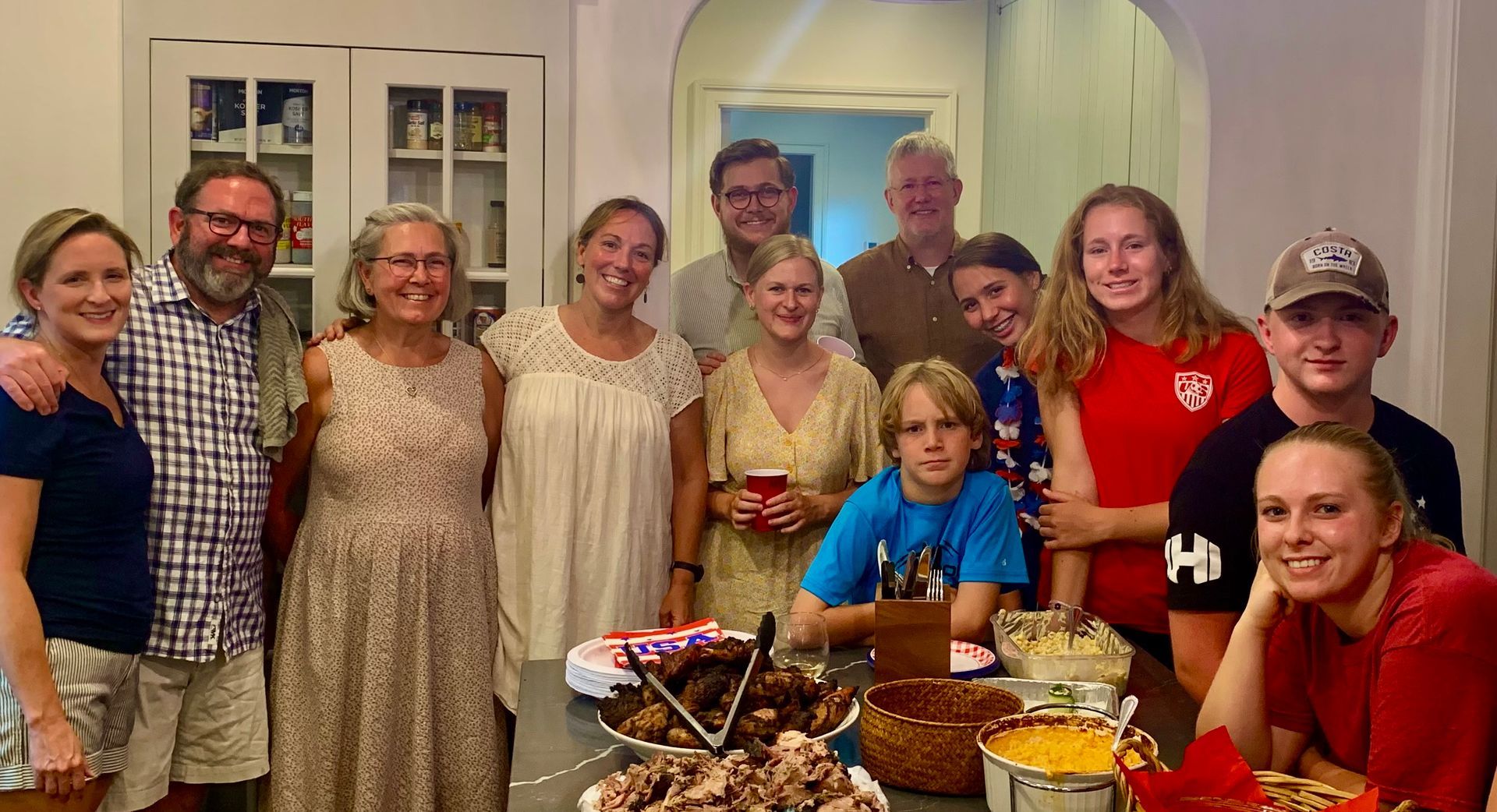
[Other stories in this issue of Church and Life are about Americans traveling to Denmark. This one, by Carsten and Sonja Jensen, is about Danes traveling to the USA and what they experienced there.]
In 2022, we spent three months living in Birmingham, Alabama, having moved there from our home in Odense, Denmark. Our stay lasted from 1 May to 30 July and, for both of us, it was one of the best experiences we’ve shared in the many years we’ve been married. We have travelled abroad on several occasions in connection with our work, but few experiences have surpassed those three months in Alabama.
A little about us: Sonja is an experienced neonatal nurse who has worked for many years at Odense University Hospital, where she has specialized in the care of premature babies. Carsten is a professor of medieval church history at the Faculty of Theology at the University of Copenhagen. We have four adult children, all of whom are now married and have families of their own. So far, we have five grandchildren aged between one month and ten years.
Our stay in Alabama was possible because Carsten had a three-month sabbatical, and Sonja had applied for unpaid leave from her job at the hospital. Originally, the plan was to spend six months in Alabama, but Carsten's role as Dean got in the way, so we had to settle for three months, which, however, turned out to be a bit of a breather for both of us.
We were lucky to find a lovely house in Irondale, a suburb of Birmingham, with a nice garden (or what Americans call a "yard"). The house had plenty of room for guests so three of our children and their spouses came to Birmingham to visit us, as did Carsten's younger brother, who has lived in New York for the past many years after spending several years in Africa. (Those three months were thus the first and, so far, only time in decades that Carsten and his brother lived in the same country — albeit in two very different states.) The neighborhood of Irondale is beautiful and very green. While Carsten did his research and wrote, Sonja often went for walks in a nearby nature reserve and wandered around the neighborhood with all its different houses, which in itself was a unique experience.
We had met Professor Busbee (the editor of this publication) beforehand, and he arranged an invitation for Carsten from Samford University, which became our formal base during our stay. Brad and his family showed us Southern hospitality, making sure we were comfortably settled into our house and subsequently inviting us to the Sunday services at All Saints Episcopal Church in Homewood, just outside of Birmingham. We settled in nicely and felt welcomed. Our own church background is the Lutheran Church, which is the majority denomination in Denmark. It has a slightly different form of service and liturgy to what we encountered at All Saints, but Carsten, himself an ordained mister (though not currently serving), was delighted to be introduced to the Episcopal tradition and its rich liturgy and church life. We learned that in Alabama, the church is the center of much social life. And, for us, too, the church proved to be a wonderful way to some of the many lovely people in Birmingham.
For Sonja in particular, the church community provided an opportunity to meet delightful ladies who warmly welcomed a Dane on foreign soil with many questions on her mind. As an accompanying wife with no obligations regarding work, home or children, Sonja felt a little nervous about how her time in Birmingham would unfold and how she might get to know others. It was therefore a great joy to discover that the church had a knitting club where she could simply turn up without much preparation. Sonja went there every Thursday and met many wonderful women. Through them, she met other lovely people and received suggestions for places we should visit – and Sonja had plenty of opportunity to practice her English.
The knitting club also became the place where knowledge was exchanged about how to knit and purl, which, surprisingly, isn’t the same all over the world. Knitting club members made small blankets, scarves, and similar items to give away to people who might benefit from them. Once a project was completed, there was a short devotional gathering led by one of the church’s ministers, who blessed the work and prayed that it might be of benefit to others.
The All Saints Knitting Club also became a way to learn about life in Alabama. The club organized a yarn-buying and sightseeing trip to Florence, Alabama, in the northern part of the state. And on the way home, they also visited Helen Keller’s Birthplace, in a lovely town called Tuscumbia. One club member named Michelle took Sonja under her wing in particular. Together they drove around the Birmingham, so Sonja could get a feel for where to shop, both for everyday goods, clothes, shoes, etc.. Among other things, they "went for a spin" in the supermarket, where there was time to talk about the various goods on the shelves and discuss the differences and similarities with Danish supermarkets. (American supermarkets are gigantic in comparison!) Michelle also introduced Sonja to another knitting club, where she met several lovely people who were all very welcoming and keen to chat – in fact, wherever we went, people wanted to know who we were and where we came from (and why on earth we’d ended up in Birmingham, Alabama, of all places).
Sonja and Carsten quickly discovered that the traffic rules were also different. The knitting club became the place where Sonja could marvel out loud that in Alabama you’re allowed to turn right in your car even when the light is red – something you’re definitely NOT allowed to do in Denmark. In addition, they discussed recipes, flowers, and . . . gun laws! Denmark is entirely different in this regard. Carsten was somewhat surprised to see a sign at the university banning guns on campus – such a sign would be completely unnecessary and therefore unthinkable in Denmark due to our very strict gun laws.
Carsten alternated between working in his office at Samford University and at home in Irondale. He managed to get two book manuscripts nearly finished in those three months, while still having plenty of time to enjoy the city and the state. In addition to having taught American church history on several occasions at Copenhagen University, Carsten has a particular interest in early European church history, with a focus on the Christianization of the Baltic countries in the Middle Ages. This was thus also the theme of the two books he was working on. And although the conversion of the Estonians, Latvians, and Lithuanians has little to do with Alabama, the setting was absolutely fantastic, and Carsten had plenty of time to immerse himself in his work.
Of course, Carsten is interested in all things historical, and his stay in Alabama provided him with opportunities to delve into the history of the state and the southern United States. This resulted in many visits to various museums and historical sites both in Alabama and in the surrounding states. In fact, we managed to visit all the states bordering Alabama, although in the case of Florida it was only a day trip. Highlights were the historical museum in Montgomery, the Taskigi Mound and Fort Toulouse at Fort Jackson Park where there is an archaeological site of a Creek Nations settlement, the Civil War battlefields at Chattanooga, Tennessee, and the incredibly well-preserved wreck of the USS Cairo, now on display at Vicksburg National Military Park in Mississippi. From the preserved crew lists, we discovered that there had in fact been several Scandinavians amongst the Cairo crew members, including some Danes. Suddenly, our own history came very close to a dramatic chapter in American history. Sitting in Natchez and simply enjoying the Mississippi River was also a great experience, as was the visit to New Orleans with one of our daughters. And then it was really lovely to pop along to the Farmers’ Market in Birmingham and enjoy Saturday in good company with friendly people, nice music, and lovely food.
Even though Sonja was on leave from work, she still had the opportunity to visit a neonatal unit at a hospital in Birmingham. In connection with this, she was also invited to give a talk to a group of doctors about Danish experiences with the treatment of premature infants, including the special approach used at Odense University Hospital, where the baby and its parents are discharged home quickly whilst technically maintaining admittance to the hospital and maintaining daily contact with the nursing staff via various digital platforms. This way, parents can ask questions about every aspect of their child’s development, and the nurses and doctors can monitor the child’s progress. It is a fantastic service for parents who would normally have to stay in hospital for a very long time with a premature baby. Now, many can instead stay at home in familiar and comfortable surroundings.
In that sense, it was quite amusing that it was Sonja who gave the professional lectures and Carsten who was tucked away in his office or at home in Irondale writing his books. It was a bit like the world turned upside down for both of us, but a wonderful experience. We very much hope to be able to return there in the future. In the meantime, we have fortunately had visitors from Alabama here in Denmark and have thus been able to return the favor a little for the wonderful experiences we ourselves had in the summer of 2022 – we will never forget them and the Southern-style hygge we experienced.
Dateline Denmark
By Edward Broadbridge
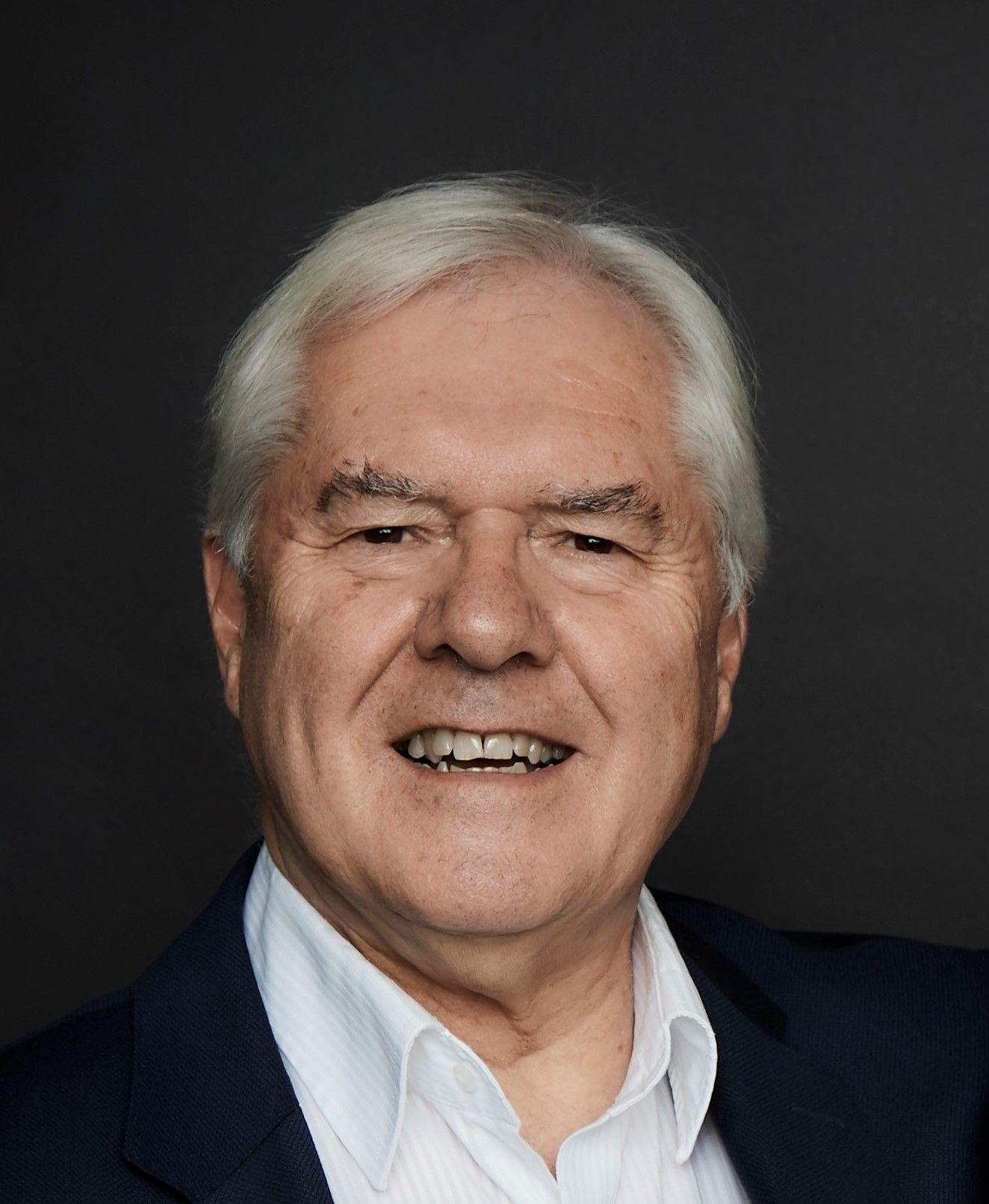
On Translating Grundtvig
by Edward Broadbridge
Grundtvig’s works have never before been extensively translated into English. Between 2008 and 2023, I translated 580,000 of his words and published them, together with a biography co-authored by Hans Raun Iversen in both English and Danish, the English title being Denmark’s Catalyst. The Life and Letters of N.F.S. Grundtvig. The 6-volume series "N.F.S. Grundtvig: Works in English" is published by Aarhus University Press.
Grundtvig did not learn English at Aarhus Cathedral School or Copenhagen University, but for a man who knew German, Latin, Old English, Norwegian, and Swedish, and had taught himself Icelandic, English was just another language that he picked up as he went along. He himself was a brilliant translator, from Greek, Latin, Icelandic, German, and Old English, but he nevertheless claimed in 1836, in a burst of national pride and prejudice, that the opposite was impossible: “I do believe that all that is beautiful and good can be translated into Danish with no loss whatsoever, while the best of Danish cannot be translated into any language, not even into English, without losing at least the half of it.”
With regard to his hymns and songs, all Grundtvig’s translators have faced the complex task of reproducing in English his contents and concepts, his metaphors and similes, his rhymes and rhythms, and the general singability of his hymns and songs. I have deliberately chosen to make the English versions follow the metre (always), the rhyme-scheme (mostly), the imagery (frequently), and the meaning (whole-heartedly).
As for his prose, an average Grundtvig sentence contains around 120 words. An average modern English sentence, say, in a novel, contains around 20-25. The longest Grundtvig sentence I have come across runs to 286 words, in On Historical Learning from 1816. The only way to deal with this verbosity is to use what I call a "salami-knife" and cut it into five edible portions – which even then may prove indigestible. However, once you have digested the content, it is actually very interesting – and a powerful testimony to Grundtvig’s anglophilia.
Sitting in a church pew on a Sunday morning and checking the hymns that we are about to sing in the course of our worship, I always look for, and hope for, one by Grundtvig. Two is a bonus. For in his hymns we are at the heart of both the tradition and the modernity of the Danish Lutheran Church – and of the Church year. At Advent and New Years, we sing "Welcome, New year of our Lord"; at Christmas children sing "A child is born in Bethlehem," and adults sing "Lovely is the midnight sky" along with a host of others; at Easter we sing "Hail, our reconciling Savior" and "Easter flower, why are you here?"; at Pentecost we sing "The sun now shines in all its splendor"; and at Harvest we sing "The forest leaves are fading fast." Grundtvig wrote the best-known hymns for Holy Baptism, Holy Communion, and the wedding ritual, while his hymn on death, "To bid this world farewell aright" is equally magnificent but less used at funerals than "Hail, our reconciling Savior."
Grundtvig is the catalyst of modern Denmark, a man whose contribution surpasses all others and has no rival in any other country as the single founder of its modern values of freedom and cooperation. Denmark is a culturally Christian country in no small measure thanks to Grundtvig. I venture to make the following comparison: no England without Shakespeare, no Denmark without Grundtvig. But where Shakespeare was a poet-playwright, Grundvig was a pedagogue-poet-pastor-politician and philosopher.
Grundtvig’s Manuscripts Online (GMO): Machine Learning and Human Judgment
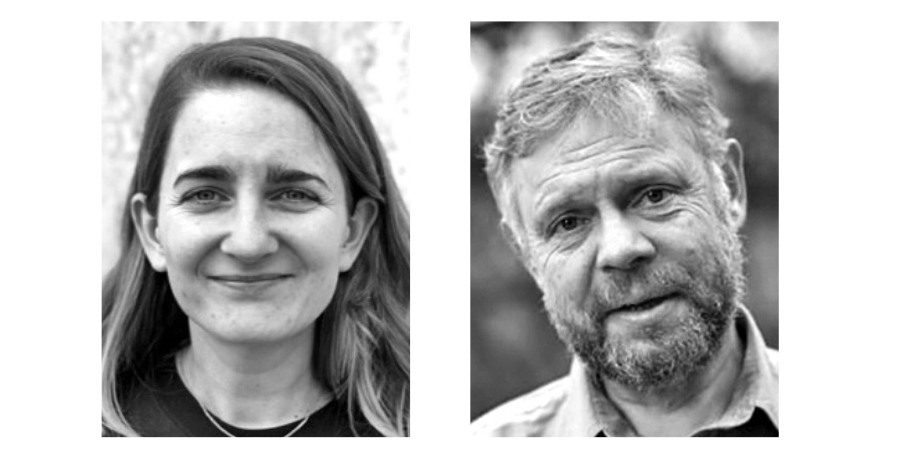
by Nanna Eva Nissen and Kim Arne Pedersen
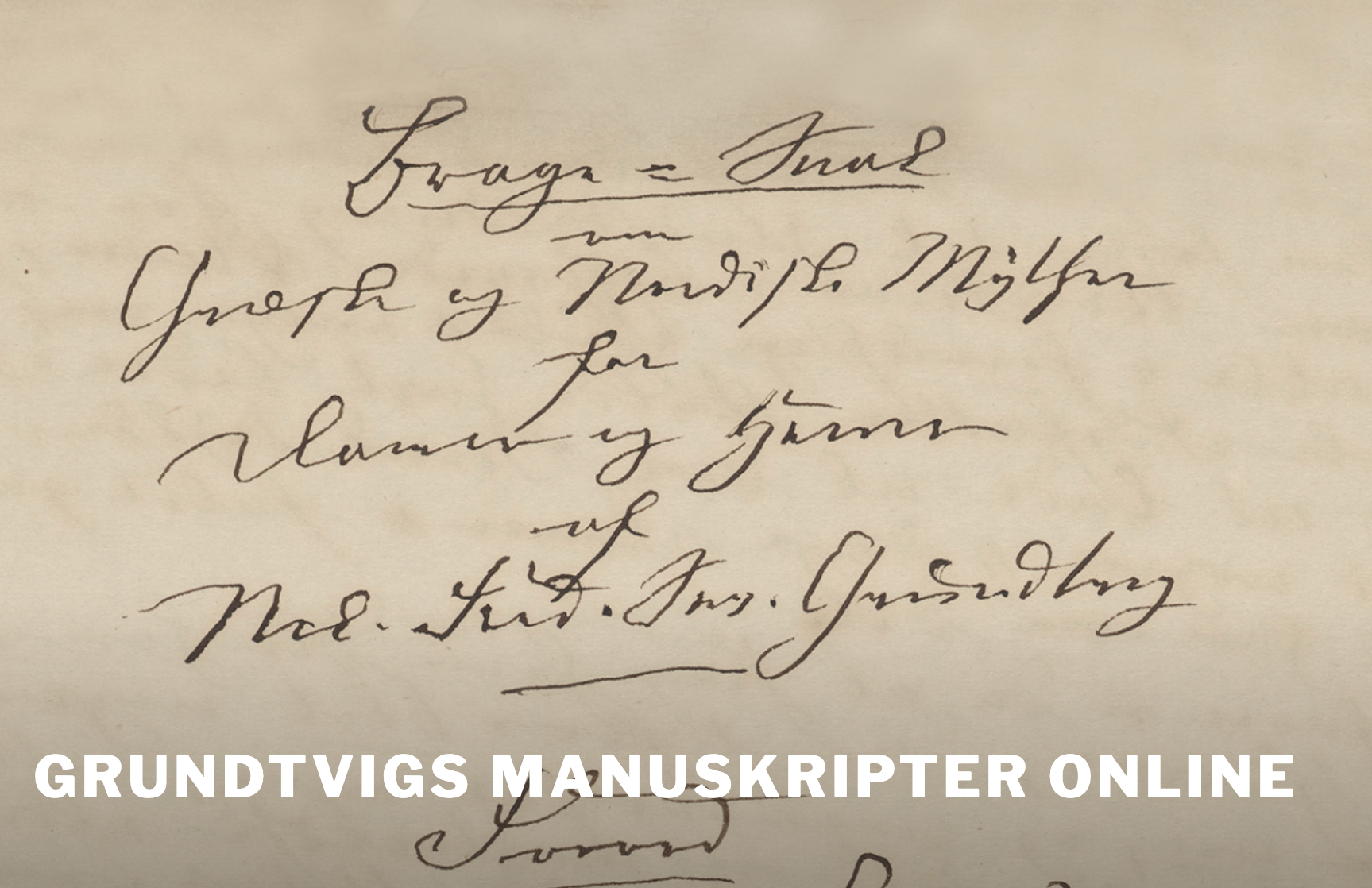
N.F.S. Grundtvig (1783-1872) has often been called the most influential individual in Danish history. Upon his death, he left behind not only an extensive body of printed works, but also around 80,000 handwritten, unpublished pages. These manuscripts are now kept in the N.F.S. Grundtvig Archive at the Royal Library (KB). The archive has long been difficult to access, partly because its structure is unclear and partly because reading Grundtvig's Gothic handwriting requires special training. As a result, researchers have made only limited use of this rich source material.
A new project called Grundtvig's Manuscripts Online (GMO) will remedy these difficulties, thanks to grants from the Augustinus Foundation and the Aage and Johanne Louis-Hansen Foundation in 2023. Over a four-year period, a digital research infrastructure will be built in a collaboration between the National Library of Denmark and the Faculty of Theology at Copenhagen University, which will make the archive publicly available in transcribed and searchable form.
GMO is planned and carried out by Associate Professor Anders Holm from the Faculty of Theology and Special Consultant Jakob K. Meile, MA, from the Royal Library, together with the two authors of this article, Nanna Eva Nissen and Kim Arne Pedersen, a team of student "transcribers" and visiting scholars. The project is based on the library's digitization of the archive. To transcribe the manuscripts, team members use Transkribus, a kind of AI software capable of learning and then automatically recognizing handwriting.
History of the Grundtvig Archive
After his death, Grundtvig's papers were in the possession of his widow, Asta Grundtvig. Upon her death in 1890, the documents were given to the National Archives and transferred to the Royal Library in 1941. The papers are now stored under secure conditions. Initially, they were bound in so-called fascicles and, in recent years, repackaged in acid-free archive boxes.
The division of the papers into fascicles is a useful structure for the large, diverse archive and has therefore been retained in the repackaging into boxes. In contrast to the orderly conditions under which the archive is preserved today, it is interesting to consider that the documents accompanied Grundtvig throughout his long life. That is, from the time he was 15 years old and began saving his written work, and when he later moved among approximately 25 different addresses where he lived. We know from memories of his home in Strandgade in Christianshavn between 1828-40 that manuscripts were scattered in a jumble together with books, inkwells, pens, tobacco pipes, and half-full tea and coffee cups on a table in front of the sofa in the study. In Skolen for Livet (The School for Life) from 1838, Grundtvig himself gives a vivid impression of his workplace – and of how his wife Lise occasionally tidied it up when she cleaned and polished the windows. Despite his immediate reluctance and fear of losing his bearings in his familiar chaos, he had to admit the usefulness of cleaning. He said, “Everything that was previously hidden in the twilight under dust and piles of paper” now came to light!
How GMO work is done
The establishment of the research infrastructure rests on two main tasks, which are carried out by ten student assistants.
First, all photographed archival documents must be marked up so that each line and each word is placed in the correct reading order. This process is called layout alignment. If a manuscript has a simple structure with headings and sections, the Transkribus tool's automatic line annotation is often sufficient. In the case of Grundtvig's writings, however, the structure of the manuscript pages is often so complex that the automatic marking requires manual adjustment – often to include Grundtvig's additions, which are often written diagonally in the margins. This work requires steady judgement and sharp reading skills in determining the correct order of often-jumbled words and sentences.
Secondly, an HTR (handwritten text recognition) model must be trained in Transkribus, which can transcribe the annotated archive material. To develop a model that specializes in recognizing Grundtvig's handwriting, a selection of manually transcribed pages is used as training data. Initially, we used existing transcriptions, which were matched with the annotated images in Transkribus. These originate from Christian Thodberg's publication of Grundtvig’s sermons from 1839-45. Because they follow a diplomatic principle and include all corrections, they are well suited for model training in Transkribus. This approach has yielded good results. With a training set of approximately 1,100 pages or 290,000 words, early on we had a specialized model able to read large parts of the archive with an accuracy of over 94 percent – and texts from the 1840s up to 99.5 percent. During this initial phase, the student assistants also had the opportunity to familiarize themselves with the layout and to read Grundtvig's handwriting with the help of the diplomatic transcriptions. At the present time, the focus is on testing the model's capabilities in other genres than sermons and in decades other than the 1840s, on which Transkribus has been trained so far.
The Register of Grundtvig's papers (which we explain a bit more below) contains information about dating and content of papers from the early days of Grundtvig. This information research helps us prioritize which documents to transcribe first. Within these prioritized documents, student assistants now can choose for themselves what they want to work on. Their task in this phase is to proofread the HTR model's machine transcription of the documents and, at the same time, mark the text where problems appear or questions arise. We expect to proofread approximately one tenth of the archive's pages in order to train a model that can machine transcribe the rest with an accuracy of 96 percent or higher.
Daily tasks
The project's student assistants are employed at the National Library of Denmark and work at the Black Diamond, the building where the library now in kept, where they share an office with other employees. The office – called the "Transcriptorium"– is located on the fourth floor with a view of Copenhagen Harbor and Knippelsbro. The view allows them to lift their gaze and “look far away,” providing a welcome break from working with Grundtvig's manuscripts and Transkribus.
It is necessary to find a good flow when working with manuscripts. In addition to breaks, variety is achieved by switching between layout adjustments and proofreading, which require different types of attention. Some days team members immerse themselves in texts on their own screen; other days they engage in lively discussions to help each other transcribe difficult words and phrases or to figure out the meaning of an unusual mark or symbol on the page.
While parts of the work are routine, other tasks require human judgment that is developed over time. Deciphering Grundtvig's handwriting is a good example: The goal is to read the text as accurately as possible, but in practice it is often necessary to decipher words based on what makes the most sense in context, because many of Grundtvig's letters are hard to tell apart. Therefore, both experience in reading handwriting and familiarity with Grundtvig's vocabulary are important prerequisites for a qualified interpretation.
Over time, transcribers develop a sense of how much energy they should invest into solving a difficult layout or deciphering an unclear word – and when it is necessary to move on for the sake of the project's progress.
Building on tradition for future benefit
GMO’s student assistants have developed their ability to read Grundtvig’s handwriting and master his language by building on the expertise that the first generation of Grundtvig researchers established in the late 1930s and refined during the two decades after 1945. Theological and humanistic research actively brings the achievements of earlier generations into the present, updating and improving them for new audiences, and GMO continues this tradition.
In its digitization work, GMO builds directly on the Registrant over Grundtvigs papirer (Register of Grundtvig’s Papers), which the Grundtvig Society of 1947 and the Danish Language and Literature Society compiled in 30 volumes between 1954 and 1964. The register contains descriptions of the contents of the individual fascicles and continues to serve as a key tool in the work with GMO. However, it was created based on a far more ambitious plan to make all of Grundtvig's texts – both printed and unprinted – available in a scholarly edition. The plan was put forward by two pioneers of Grundtvig research, the literary historians Helge Toldberg and William Michelsen, on behalf of Hal Koch in 1946.
Significance and potential of GMO
When Tolberg and Michelsen realized that their project would comprise 130 volumes, they made the decision to register rather than publish. Fortunately for us, times have changed: The Center for Grundtvig Research at Aarhus University is currently publishing an online edition of all of the texts Grundtvig published during his lifetime. That project is called "Grundtvig's Works." The project, together with GMO, will realize Toldberg and Michelsen’s dream to ensure that nearly everything Grundtvig wrote will be made available.
GMO therefore represents a major step in exploring Grundtvig's life and works. For the first time, it will be possible to search across manuscripts and published texts. Research into Grundtvig's work will doubtless move in new directions, and new light will be shed on Grundtvig's contribution to Danish history. GMO thus offers unprecedented opportunities to examine Grundtvig's use of sources, as the manuscripts are often more revealing than the printed texts. Preliminary studies already reveal that the established image of his studies in antiquity will change and that the view of his relationship to 18th-century scholarship will be different.
GMO will also significantly change research into Grundtvig's spoken texts, like his sermons and speeches. Grundtvig spoke freely but he always wrote out his ideas in advance. The manuscripts therefore give special insights into the evolution of his ideas. These have been preserved in the archives, and GMO will therefore not only be able to clarify obscure passages in the often-sparse reports of his speeches; it will also shed light on contemporary reactions to them. These are just examples of GMO's scientific output. Only the future can tell what lies ahead, but the project will undoubtedly change Grundtvig research.
Greenland, Denmark, and the USA
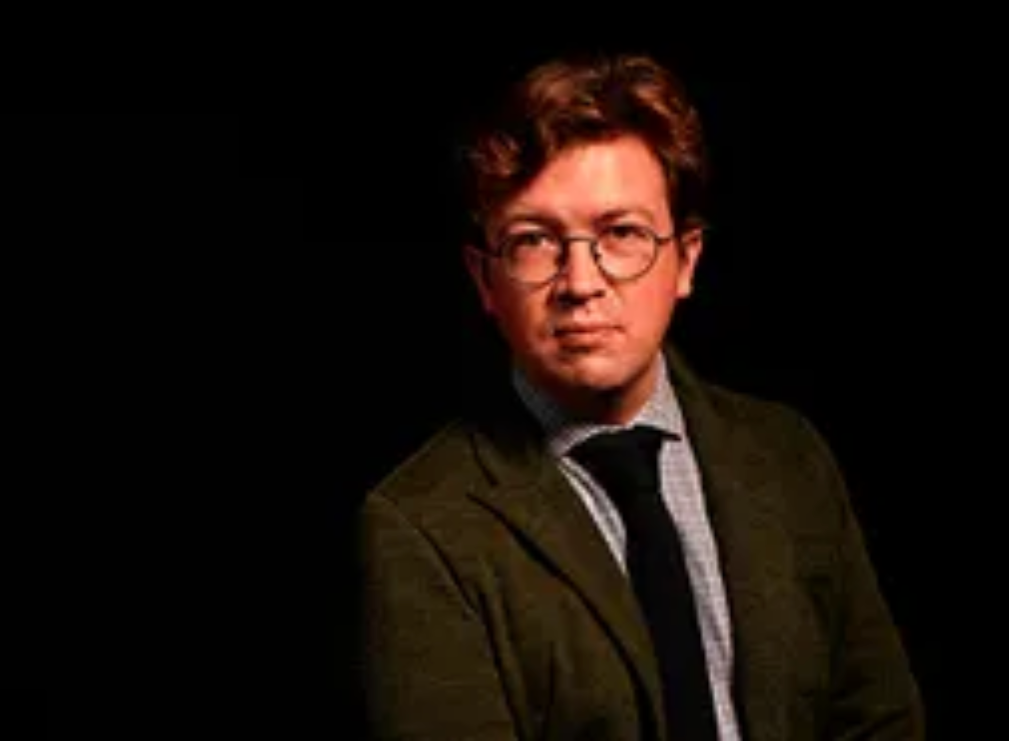
by Jens Lei Wendel-Hansen
“. . . The fact that they had a boat land there 500 years ago doesn’t mean that they own the land.” These are words from President Donald Trump in January of this year, regarding Greenland being a part of the Kingdom of Denmark. Around the same time, Trump's political advisor Stephen Miller in a CNN interview posed the following rhetorical questions: “By what right does Denmark assert control over Greenland? What is the basis of their territorial claim? What is their basis of having Greenland as a colony of Denmark?”
Comments and questions like these suggest that the US government desires to make Greenland a part of the US in some form. To Danes, they were not surprising — Trump offered to buy Greenland in 2019 — but they were, from Danish and Greenlandic perspectives, still strange and terrifying.
The strangeness of the suggestion was encapsulated in 2019, when Mette Frederiksen, referred to Trump's offer to buy as “absurd.” After all, the Greenland Self-Government Act of 2009 states that Greenland is recognized as “a people pursuant to international law with the right of self-determination" and, on this basis, the Danish government line is, and will likely remain, that the decision of affiliation remains with the Greenlandic people. Recently, Greenlandic prime minister, Jens-Frederik Nielsen, made his country's position very clear when he said, “If we are to choose between the US and Denmark here and now, we choose Denmark.”
Even so, the relationship between Greenland and Denmark is a complicated one, and narratives of the shared history of the two countries have triggered discussions in Greenland about independence. Thus, it was not certain that Nielsen's statement would be a politically safe one for a Greenlandic prime minister to make. But Greenlanders seemed to agree: In the recent general election to the Danish parliament, the majority of the Greenlandic vote went to the present coalition parties, in essence to maintain the status quo.
The purpose of this article is to step back from what is observably the status quo of Greenland-Denmark relations. I hope to answer the questions posed by Stephen Miller with some historical perspective.
A secondary purpose is to explain the Danish and Greenlandic political and ideological connection, which to some extent can give depth to the Greenlandic prime minister's statement.
Scandinavian presence in Greenland began in the 11th century, and it declined between the 15th and 17th centuries. Occasional expeditions to Greenland from Denmark and Norway maintained some Scandinavian influence, but long-term permanent European presence began in earnest in 1721, when the missionary Hans Egede set foot on Kangeq (in Danish called: “Håbets Ø," which is “The Island of Hope” in English). Egede’s motivation was evangelization, but as a pietist, he emphasized the sincerity of conversion, thereby making it crucial that the mission was taking place in the Greenlandic language. Thus, the mission was largely carried out by converted Greenlanders, which explains why the Danish administration and Greenlandic society in general continued to function in the native tongue and a principal reason why the language survives today.
Hans Egede was Norwegian but, at the time, Norway was part of Denmark, and Copenhagen controlled Greenland from the 1770’s through the Royal Greenlandic Trade Company. When the union between Denmark and Norway ended in 1814, the colonies on the west coast of Greenland continued trade with Greenlandic hunters. The trade was not particularly lucrative, but it occasionally rendered enough profit to finance Greenland's administration and mission activities.
In the 1850’s, the Danish government was forced by international conventions to establish a common constitution for the four parts of the Danish monarchy: The Kingdom of Denmark, the bicultural duchy of Slesvig, and the German duchies of Holstein and Lauenburg. By 1849, the Kingdom of Denmark already had a constitution, but it left questions unanswered. For instance, how was the Kingdom expected to manage and regulate dependent territories like Greenland?
Grundtvig played a role in the writing of the constitution, and he took part in this discussion about Greenland in his capacity as a member of the Danish lower house, Folketinget. He was very firm in his opinion that Greenland was part of the North.
Greenland was therefore not German, and the Danish king’s German subjects were not to have any say in the matter of Greenland. The debate, and particularly Grundtvig's statements about Greenland in 1855-56, showed that Greenland played a crucial part in Danish self perception. Greenland, as well as the other North Atlantic countries in the Danish realm like The Faroe Islands and Iceland, linked Denmark to the North and Norse heritage, since the first Northerners had set foot on Greenlandic during the Viking Age.
Like others in his time, Grundtvig clearly regarded Greenlanders as untouched by civilization. He saw them as pure and unaffected by societal evils, and he promoted the popular opinion that Greenlandic life, language, and culture should be left untainted by civilization. A similar argument, but following a different line, came from Danish government representatives within Greenland itself. They wanted Greenland left alone to ensure that Greenlanders would not be subject to the horrific abuse that the Native Americans in the US were experiencing.
This was Denmark's policy regarding the Greenlandic population until World War II. Then, between the 1950s and the 1970s, the policy changed when it came into conflict with questions of modernization.
Broadly speaking the conflict between preservation and modernization can be characterized as follows:
Because of the traditional position that Greenlandic culture should be protected and preserved, Greenlandic leadership began to fear being trapped in an open-air museum. They saw this treatment as degrading, and they began to demand modernization, particularly in developing a welfare state similar to what was evolving in the Scandinavian countries. Previously, during the first half of the 20th century, they had also demanded greater links to the outside world. The first three novels in Greenlandic, published in 1914, 1931, and 1934, reflect these demands in some way. Even the culturally conservative (and cautious) figure, the reverend and poet Henrik Lund wrote,
The advanced peoples have set us an example,
and we too will strive to follow it,
while the world of books is our walking staff,
carrying us forward and giving us new strength.
These lines became part the national anthem of Greenland.
And so the Greenlandic push for modernization and connection with the rest of the world came into full swing. The Danish government was hesitant but couldn't maintain its current policies toward Greenland. As the post World War II world was confronted with United Nations demands for decolonization, the Danish government found it impossible to maintain its protect-and-preserve policy.
The government therefore followed a new solution. Decolonization of Greenland would happen through integration rather than separation. Greenland formally became a country in Denmark, and it is from this evolution that the present status of Greenland derives. Constitutionally, Greenland is not a territory, a colony, or dependent region. It is an integrated part of the Kingdom of Denmark.
But while the modernization process revolutionized Greenland, it was at times painful. The Danish administration moved too quickly, often instituting changes without including or consulting Greenlanders in the process. The result was that many Greenlanders developed an identity crisis. Were they Greenlanders or Danes or neither? The nation also developed what could be called a collective trauma as the result of a glaring lack of Danish consideration of the hopes and needs of Greenlanders themselves. The most well-known (and most discussed today) tragic example of the Danish administration's many mistakes is the IUD case, an expansive campaign in the 1960’s and 1970’s to control the birth rate in Greenland. The campaign left many very young women incapable of being bearing children, in certain extreme cases without the prior consent or knowledge from parents or the young women themselves.
The resulting outrage inspired demands for Home Rule, first introduced in 1979, which led to broader self-government thirty years later.
In 1916, the USA officially recognized Danish sovereignty over Greenland, but since 1941, the defense of Greenland within NATO has been a shared endeavor of the USA and Denmark. The Danish government has given the USA the freedom to develop its military presence in Greenland. Therefore, when Stephen Miller speaks of Greenland as a colony, he is wrong, and when President Trump questions Danish sovereignty, he is denying American recognition of Danish sovereignty for more than a hundred years.
Jens Lei Wendel-Hansen, Ph.D., is a former assistant professor, University of Greenland, now senior researcher, Center for Grundtvig Studies, Aarhus University, Denmark.
Danish Politics in Spring of 2026
by Karoline Præstholm
As a graduate student in Political Science at Copenhagen University, I am doing an internship this semester at the Danish Broadcasting Corporation, also known as DR. It is Denmark's national public-service broadcaster, founded in 1925 and operating as a state-funded entity under a public service contract. DR provides news through radio, TV, podcasts, and online platforms.
This semester has been especially exciting working at DR because it has been a major political season in Denmark. We recently had national elections and, because my interests lie in investigative journalism and documentaries, I found myself in the middle of the action. What follows are some observations about the state of Danish politics (and a few words about how it works) in the spring of 2026, which has been an incredibly interesting time for Denmark nationally and globally.
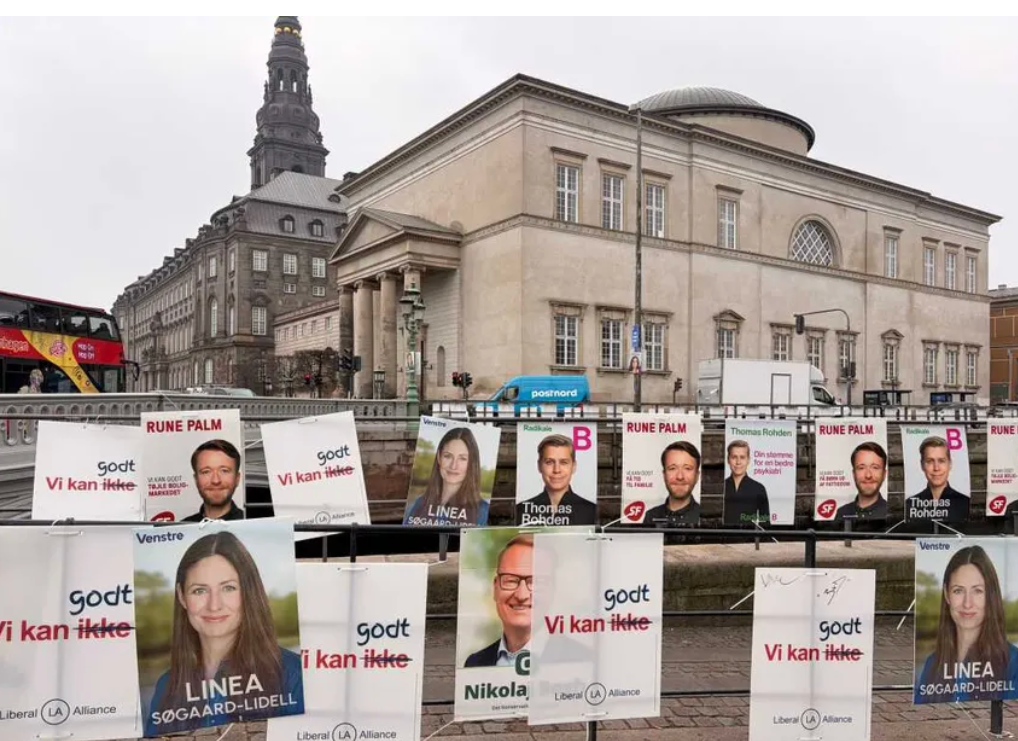
During the build-up to election day on 24 March, I helped prepare TV and radio interviews with leaders of the 12 political parties running for election. (Yes, we have 12 political parties! More on that below, the good and the bad aspects of it.) From February, when the elections were called, until the elections, I did background research for interview preparation, mainly by identifying relevant topics and questions for candidates. Our task was to highlight potential contradictions in candidates’ political promises and visions and give them a chance to explain their positions. It was especially exciting to develop questions for the Prime Minister (Statsminister), Mette Frederiksen, and the Minister of Defense (Forsvarsminister), Troels Lund Poulsen!
When it comes to elections, an important thing for Church and Life readers to understand is how representation works in the Danish system. Where the US has Congress, we have Parliament. This is an obvious surface difference, but another crucial one comes with it: While the U.S. has majority elections in single-member constituencies, an election process that tends to produce a two-party system in Congress—in the USA’s case, it’s the Democratic and Republican parties—Denmark has a proportional representation system which leads to a multi-party system in the Danish Parliament. As a result, we have all kinds of parties, representing several overlapping political interests and ideologies. The parties end up having to work together, to compromise, on most issues—which is both difficult and positive. Party power, however, depends upon the level of electoral support the party receives. In other words, the proportional election system guarantees that parties get a number of seats in parliament that corresponds to their share of the vote. So, for example, when a party receives 6% of the votes nationally, it also gets roughly 6% of the 179 seats in Parliament (with some minor deviation). The proportionality is not exact because of technical electoral rules like the “electoral threshold” at 2% of the votes nationally. This means that a party must get at least 2% of the vote to have a seat in Parliament. Below that, no seat is offered. In the U.S., smaller parties are often disadvantaged and have no say whatsoever, since only one candidate can win in each constituency.
But while we have 12 parties, two usually vie for the most power, as in the USA. The difference in Denmark is that these two absolutely must work with the other parties along the way. Since the early 20th century, Social Democrats and the Liberal Party have historically been the two dominant parties in Denmark. Traditionally, the Social Democrats have represented the working class and the labor population. The Liberal Party (originally the Agrarian Party) has traditionally represented farming and rural interests. Over the years, one of these two parties has ended up leading a governing coalition: The Social Democrats would typically get support from other left-wing parties, while the Liberal Party would typically get support from other liberal and conservative parties. Traditionally, Danish national elections were often framed around one question: Would the left-wing bloc or the right-wing bloc get the parliamentary majority of 90 seats and thereby form a government?
In the last couple of years, however, that question and anticipated answers have been significantly challenged. Following the national election in 2022, Denmark experienced a highly unusual centrist governing coalition that consisted of both the Social Democrats and the Liberal Party, along with the Moderates—a newly established party in the political center, now led by the former prime minister Lars Løkke Rasmussen. The ’22 election marked the first time in more than four decades that the two historically opposing parties governed together. This government has overseen what has been called a “reform-oriented political program” focused on 1) increasing employment, 2) restructuring the economy, and importantly, 3) increasing defense expenditures to contribute to the war in Ukraine.
If you need to know one thing about the election that was held on 24th of March, it is this: the electoral landscape has now become even more fractured than it was in 2022.
Here’s how: The Liberal Party has decreased to around 10% of the vote, while the Social Democrats received around 22%, their worst result in over a century. At the same time, several other parties have gotten the same vote shares of around 8-10%. These numbers tell us that there is a much more balanced or evenly distributed support across the political spectrum. Political analysts argue that Denmark has become a patchwork of competing blocs, and some have also described the elections results as the possible end of the traditional mass party era, of the days when the Social Democrats or the Liberal Party clearly controlled a government coalition.
What has caused these changes in the Danish political landscape? From what I’ve seen, the most notable cause would be international tensions, which have gained a lot of media attention and caused a lot of national anxiety in Denmark. Donald Trump's threats about potentially taking control of Greenland made the questions of international leadership and security intensely salient in Danish public debates. Many political analysts also point out that in February Prime Minister Mette Frederiksen decided to call for elections in March because she was riding a wave of popularity. People generally liked how she handled herself and led in the face of Trump’s threats. But there’s also the fact that, as in the US, rising food and fuel prices are affecting many voters. People are concerned about affordability. And yet another factor is, without doubt, the environment, particularly as it affects daily life. Political debates regularly featured issues like the need for pesticide-free drinking water and demands for pesticide regulation in agricultural practices. Citizens in some areas even call for banning pesticides altogether. Further down the list of issues but still important in Denmark is the pork industry, which has become a debate topic because of reports of poor animal welfare conditions.
But there are other atmospheric issues changing Danish politics. In recent years, we have been seeing some of the same polarizing tendencies that people in the USA are experiencing. Danes are increasingly getting their news from social media, where politicians can present their political visions without facing critical questions or content moderation. Related to this is the rise of personality-driven political parties, where the identity of politicians becomes more important than their actual political positions.
On a positive note, though, the Danish Parliament operates through collaboration. Even politicians with very different ideologies must work together, since no party has the majority on its own. Compromises and pragmatic solutions are central to how legislation is passed in Denmark. Interestingly, levels of collaboration and broader political agreements across the political spectrum have only increased, even and especially in response to the external threats Denmark is currently facing. From what I’ve seen, it seems to me that unity, both within Denmark and with European political allies, is crucial and should be the response to what scientists have called “political fragmentation”!
Danebod Folk Meeting 2026
This is a reminder to mark your calendar for the Danebod Folk Meeting in Tyler! New friends are made, old friends reunited. Teachers and students learn from each other. These are some of the foundational tenets of the Danish folk school tradition and the annual Danebod Folk Meeting. At the 2026 Folk Meeting, August 19-23, professionals and participants will come together for three and a half days of mutual hands-on learning.
This is your opportunity not only to hear from experts on topics such as economics, political campaigns, and new methods for learning with Legos, but also to let your voice, questions, and curiosity be heard! All events, from lectures to leisure, are designed for maximum interaction and engagement.
Don’t let another season go by. Mark your calendars today, and join us in Tyler for three days of lively discussions and experiential learning! Contact me,
Anita Young, for information: 612-860-8070.
Postscript
by Brad Busbee
The travel narratives featured in this issue got me to thinking about how the lessons of travel might be understood alongside N.F.S. Grundtvig's experiences and reflections on his own travels. Since January, I have been sitting with Grundtvig's unpublished writings through my work with GMO (see the article above by Nissen and Pedersen), and I've reread his notes from his research trips. As a traveler myself in Denmark, I have also been thinking about what it means to visit and live for a time in a foreign culture, just as Grundtvig did in England in 1829.
Of course, modern travel differs greatly from what it was for Grundtvig: Today, if it's not done for business or work, it's done for escape or leisure and discovery or exploration (of place, of culture, or of self). In the early 1800s, travel was difficult and dangerous, and it was done mostly out of necessity and rarely for pleasure. In 1829, Grundtvig was encouraged to apply for a royal grant to travel to England to research Old English manuscripts. The king of Denmark graciously supported him, and he made three now-famous trips in the summers of 1829, 30, and 31, each time for three or fewer months. The trips proved to be of very great consequence to Grundtvig and to his country.
At that time, there was no such thing as a commercial travel industry and no national railway in England or Denmark. Grundtvig's notes in his 1829 daily calendar from when he set out on May 3rd until he arrived in London on May 16th give an idea of what he faced. He writes:
- (Sunday, 3 May) In God’s name, I set sail from Copenhagen with Captain Andresen . . .
- (Monday, 4 May) We sailed into the Kattegat and reached roughly the highest point near Gothenburg. [The Kattegat is the body of water between Zealand and the southwest coast of Sweden.]
- (Tuesday, 5–Friday, 8 May) Almost constant headwinds or calm conditions, so we barely managed to get out of the Kattegat.
- (Sunday, 10 May) I held a short service with the ship’s crew in the North Sea under a mild but favorable gale.
- (Wednesday, 13 May) . . . we sailed with calm and headwinds until the wind shifted at noon and brought us into the Thames on a lovely evening.
- (Saturday 16 May) I went ashore in London, but without clothes or lodging, so I returned on board in the afternoon, tired and somewhat impatient.
- (Monday, 18 May) I fetched my clothes ashore and found lodging at 28 Norfolk Street by the Strand, but a stranger, lost, impatient.
- (Tuesday, the 19th:) By a stroke of luck, I found Lincoln’s Inn, and in the afternoon, in the midst of my deepest despondency, received an invitation from Mr. Miller to join him for breakfast the following morning.
Eventually, Grundtvig settled into more permanent accommodations and for Thursday, May 28, he writes, "I began comparing my Beowulf with the codexes in the museum."
With this entry, Grundtvig's travels to England began to take a positive turn. He was finally in his element, where he wanted to be, fulfilling the purpose of his long journey. His impatience, loneliness, and despondency had begun to fade. [As a side note the work Grundtvig did with the Beowulf manuscript is one of the reasons I am now in Denmark, sitting with his writings from the summer of 1829]. With each subsequent summer, Grundtvig's confidence grew as, no longer a stranger, he made personal connections with his hosts.
Like the travel narratives in this issue, Grundtvig's account suggests that initial difficulties might be a necessary part of any meaningful journey. Challenges might even make journeys particularly worthwhile. In fact, the word "travel" originates from the Old French word "travail," which originally meant "to work," "to labor," and in many cases "to suffer" and in few cases it meant "to suffer the pangs of childbirth." The term entered Middle English around 1300 as "travaile," which primarily meant "torment" or "struggle" and it wasn't until around 1500 that the word came to mean "a journey." (The Danish word for travel is "rejse," which has a quite different etymology. It comes from Middle Low German "rēsēn" which meant "to set out.") Even so, the words "travel" and "rejse" carry the sense of impermanence, of passing through, and return. Travel/rejse is circular with an immanent (or hoped-for) return as a key element. Considered this way, travel challenges or difficulties are not considered permanent.
Decades after his trip, Grundtvig wrote that he had "never been closer to despairing than when [he] first came to England," and he complained that "Englishmen are not among those to accommodate themselves to foreigners."
We read remarks like these with expectations about how travel narratives typically work; we expect that the protagonist will overcome poor hosts or circumstantial inconveniences. Unsurprisingly, Grundtvig did. He decided bravely to "stick his finger in the soil and sniff out where he was." Through determination, he managed to gain the support (though half-hearted) of English antiquarians and a publishing house to print a multi-volume edition of Old English literature (though these plans eventually fell through). In a series of lectures years later, he added another dramatic framework to his travels: His trips to England were like Viking raids. He said, "The first summer I was in England—for just like the Danish Vikings I made only summer expeditions—the Englishman viewed me as a half-crazed poet" who sought to raid treasures buried in British libraries. It's not surprising that Grundtvig would process his experiences this way. (Sid Bradley calls this narrative flourish "self-mythologizing," which might be accurate.)
The authors of the travel stories included here don't self-aggrandize. Instead, they locate deeper meaning in what happened and who they met. They might not realize it, as Grundtvig seems to have, but every journey has something of the heroic in it: The traveller leaves the comfort of home, endures challenging circumstances and returns with more knowledge— the cumulative result of a "quest" that is in reality an answer to a question, one the traveler might not have realized beforehand. In other words, travel is about finding meaning in experience. Not to do so is a waste. The influential German philosopher Immanuel Kant wrote that "thoughts without experience are empty; experience without thought is blind." A quick glance reveals the practical validity of Kant's observation — today as well as in Grundtvig's day.
Note: If you are interested in N.F.S. Grundtvig's adventures in England, see S.A.J. Bradley's
N.F.S. Grundtvig: A Life Recalled
(2008), pages 129-135, from which I have quoted in this postscript.
Gifts to Church and Life
Supporting contributors ($ 21- $ 50)
Martin Koefoed
Susan and Albert Bodaski
Nickoline and Thomas Chittick
Thank you for your support!
All readers are welcome to make a donation clicking on the “Make a Donation” icon when they enter the website churchandlife.com or they can mail a check (Pay to the order of Church and Life) to:
Andrés Albertsen
1405 19th Ave SE Apt 103
Willmar, MN 56201